How Many Acne Scar Lasers Are There — Pico · CO₂ · ER:YAG · MNRF
Compare every acne scar laser — Pico, CO₂ Fractional, ER:YAG, MNRF — which layer each works on, which scars they suit, and the price. Dr. Big explains simply.
3D SKIN MODEL
Fractional CO2 laser
Quick answer: There are four main “acne scar lasers” — Pico, CO₂ Fractional, ER:YAG, and MNRF (technically not a laser) — each working on a different skin layer and suiting a different scar type. No single device does it all, so combining them at the right depth is what makes acne scars improve ~60–80%. At Clarity all four run in one session for 5,000 THB.
“Acne scar laser” sounds like one machine that does everything — but in reality there are several types, each working on a different skin layer and suiting a different scar type.
Dr. Big breaks it down clearly: Pico Laser, CO₂ Fractional, ER:YAG, and MNRF (not technically a laser but works similarly) — how they differ, what they can do, and the price.
How acne scar lasers work
The basic principle is “controlled injury” — heat energy creates tiny wounds in a target layer to trigger new collagen. What makes them differ:
- Wavelength — determines what absorbs it and how deep it penetrates
- Mode — Ablative (ablates the surface) vs Non-ablative (under the surface only)
- Fractional — splits the beam into tiny points vs a wide area
The 4 main acne scar lasers

1. Pico Laser
532/755/1064 nm · non-ablative · picosecond pulses · destroys pigment. Suits: dark marks at the scar base · doesn’t directly reduce scar “depth.” Pico makes tone more even so scars look lighter, but it’s not a device that shallows scars — some clinics sell Pico claiming it treats scars; really it only reduces dark marks.

2. CO₂ Fractional Laser
10,600 nm · ablative · fractional · ablates the surface in points so the body repairs and builds collagen. Suits: box scars, surface texture, scar edges. Works in the epidermis and shallow dermis — strong, fast results, but 5–7 days downtime (redness, swelling, peeling).
3. ER:YAG Laser (Erbium)
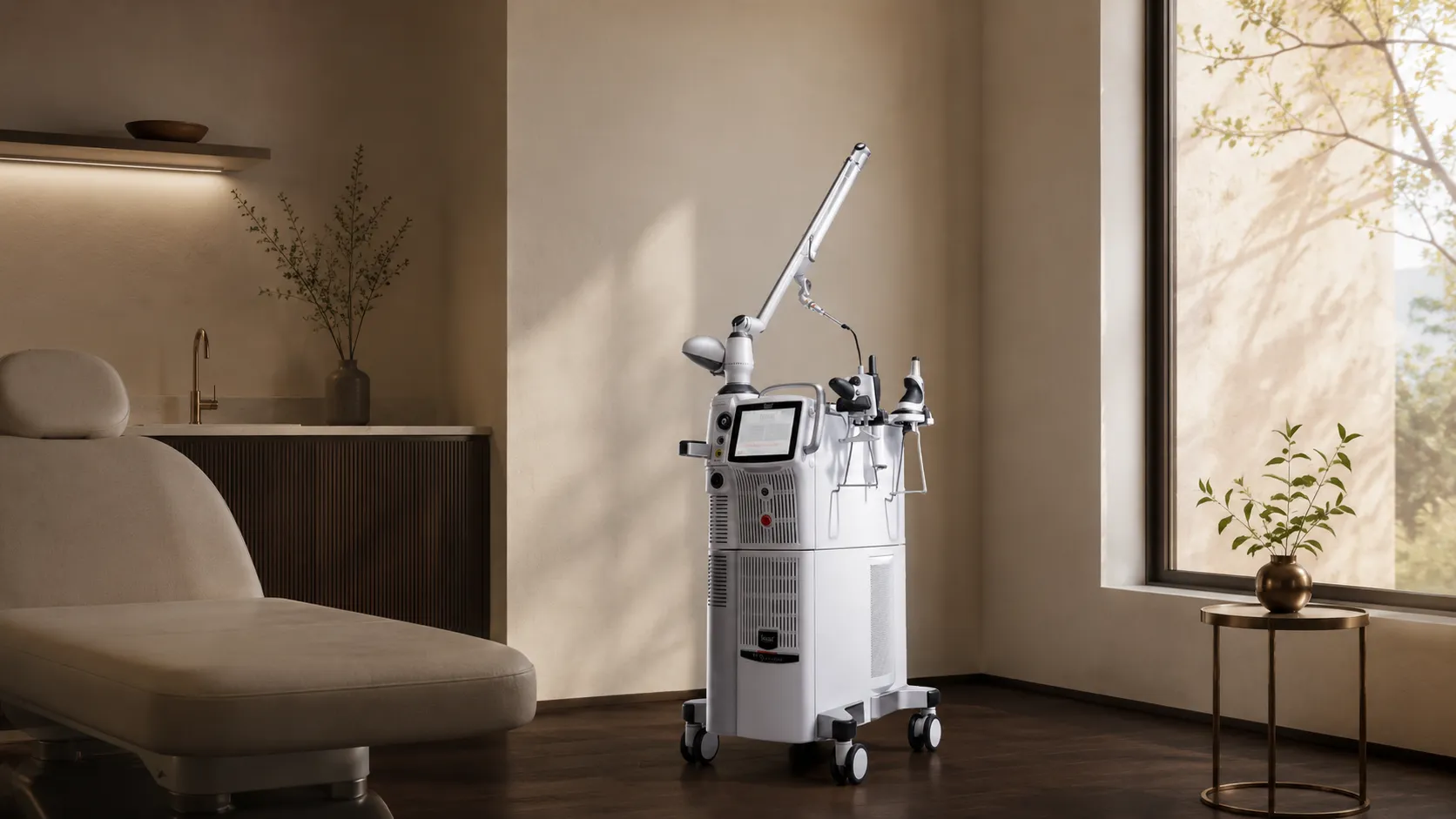
2,940 nm · ablative · more controlled than CO₂ — less damage, shorter downtime. Suits: thin skin, heat-sensitive skin, shallow scars. Absorbed more by water than CO₂, so less surrounding heat damage.

4. MNRF (Microneedle RF) — not a laser, but similar
Tiny needles release radiofrequency into the dermis · doesn’t ablate the surface — heats the dermis directly · builds new deep collagen. Suits: rolling scars, box scars, skin needing collagen. Strengths: short downtime · works right where collagen is lost · adjustable needle depth. At Clarity it’s the core of collagen building, done after Subcision.
Comparison
| Technique | Works on | Suits | Downtime | Typical price |
|---|---|---|---|---|
| Pico Laser | Surface + pigment | Dark marks at base | 1–2 days | 5,000–18,000 |
| CO₂ Fractional | Epidermis + shallow dermis | Box scars, texture | 5–7 days | 8,000–25,000 |
| ER:YAG | Epidermis (gentle) | Thin skin, short downtime | 3–5 days | 6,000–20,000 |
| MNRF | Dermis (collagen) | Rolling scars | 1–3 days | 5,000–15,000 |
Is one device enough?
Not enough for most acne scars, because they sit across several layers at once: pigment at the base → Pico · edges and texture → CO₂ or ER:YAG · collagen beneath → MNRF · tethering bands → Subcision (read the Subcision article). One device treats only one part. At Clarity all 4 are done in one session — the gold standard research recommends worldwide.
The order of devices
At Clarity per session: 1) numbing 20–30 min · 2) Subcision (release bands first) · 3) MNRF (deep collagen) · 4) Ablative Fractional Laser (CO₂/ER:YAG) · 5) Picolaser (base pigment) · 6) cooling + aftercare. Total 30–45 minutes.
Price in Thailand vs Clarity
Combined-technique acne scar treatment: small clinics 15,000–25,000 · mid-tier 20,000–35,000 · premium/hospital 30,000–60,000 · Clarity 5,000 baht/session for all 4. Why? We don’t sell course packages, no promos, no hard sell — one “real price” all year, no surprises in the room.
Does Pico really treat acne scars?
Many clinics sell Pico claiming it treats scars — really Pico reduces dark marks, not scar depth. If someone says scars shallowed after Pico, it’s likely because (1) base dark marks faded, making scars look subtler, or (2) Pico was combined with another technique (e.g. MNRF). Pico is a good device, but not a structural fix — don’t believe “Pico alone is enough.”
Which laser is safest?
All 4 are safe with an experienced doctor — chosen by skin type: dark skin — caution with ablative (PIH risk); start with MNRF + Pico · sensitive skin — start with ER:YAG + MNRF · oily/young skin — CO₂ Fractional works well · older skin — focus MNRF + Subcision. At Clarity, Dr. Big assesses every time and tailors the program.
Frequently asked questions
Q: Does laser thin the skin? A: No — Fractional Laser builds new collagen, thickening skin long-term.
Q: Does laser widen pores? A: The opposite — new collagen tightens pores.
Q: How many days off after laser? A: Pico+MNRF — next day · CO₂ — 3–5 days.
Summary
There are several acne scar lasers, each different — no single device does everything. The most effective treatment combines techniques at the right layer per spot. At Clarity all 4 (Subcision + MNRF + Ablative + Pico) in one session for 5,000 baht — one price, no course lock-in.
Contact:
- LINE: @clarityclinic — send a photo of your acne scars for Dr. Big to review
- Location: Spring Tower, B Floor · Ratchathewi, near BTS (Siam, Phaya Thai, all Bangkok)
- Free 30-minute consult with Dr. Big in person
- Price 5,000 baht/session including all main procedures · pay per session, no course packages
Read next:
- MNRF vs Ablative Laser
- TCA Cross for ice pick acne scars
- Acne mark laser types
- What is Subcision
- Acne scar types
References
Outcomes vary by individual; this article is educational, not a substitute for in-person medical assessment.
- Manstein D, Herron GS, Sink RK, et al. Fractional photothermolysis: a new concept for cutaneous remodeling using microscopic patterns of thermal injury. Lasers Surg Med. 2004. PubMed
- Gozali MV, Zhou B. Effective treatments of atrophic acne scars. J Clin Aesthet Dermatol. 2015. PubMed
- Chung HJ, Al Janahi S, Cho SB, Chang YC. Chemical reconstruction of skin scars (CROSS) method for atrophic scars: a comprehensive review. 2021. PubMed