What Is Subcision — Releasing Fibrous Bands to Treat Acne Scars (Best for Rolling Scars)
Subcision releases the fibrous bands under the skin — a technique lasers can't do, best for rolling scars. Dr. Big explains the process, pain, price, and real results.
Want to know if your scars are tethered?
Add LINE @clarityclinicthen come in for an assessment with the doctor
ARTICLE SUMMARY · 1:01
What is subcision for acne scars? A one-minute summary
3D SKIN MODEL
Subcision
Quick answer: Subcision uses a special needle under the skin to release the fibrous bands tethering a scar into a depression — something lasers can’t reach — so the body builds new collagen to lift it. It’s the first-line choice for rolling scars; over 3–6 sessions acne scars improve ~60–80%. At Clarity it’s part of the 5,000 THB per-session program (pay per session, no course packages).
Among all acne scar techniques, Subcision is the one that “lasers can’t do” — because it works in a layer deeper than lasers reach.
If you have rolling scars (curved depressions) and have lasered several times with no improvement, Subcision is the missing piece in your treatment plan.
This article explains what Subcision is, how it works, who it suits, how much it hurts, the price, and when you see results.
What is Subcision?
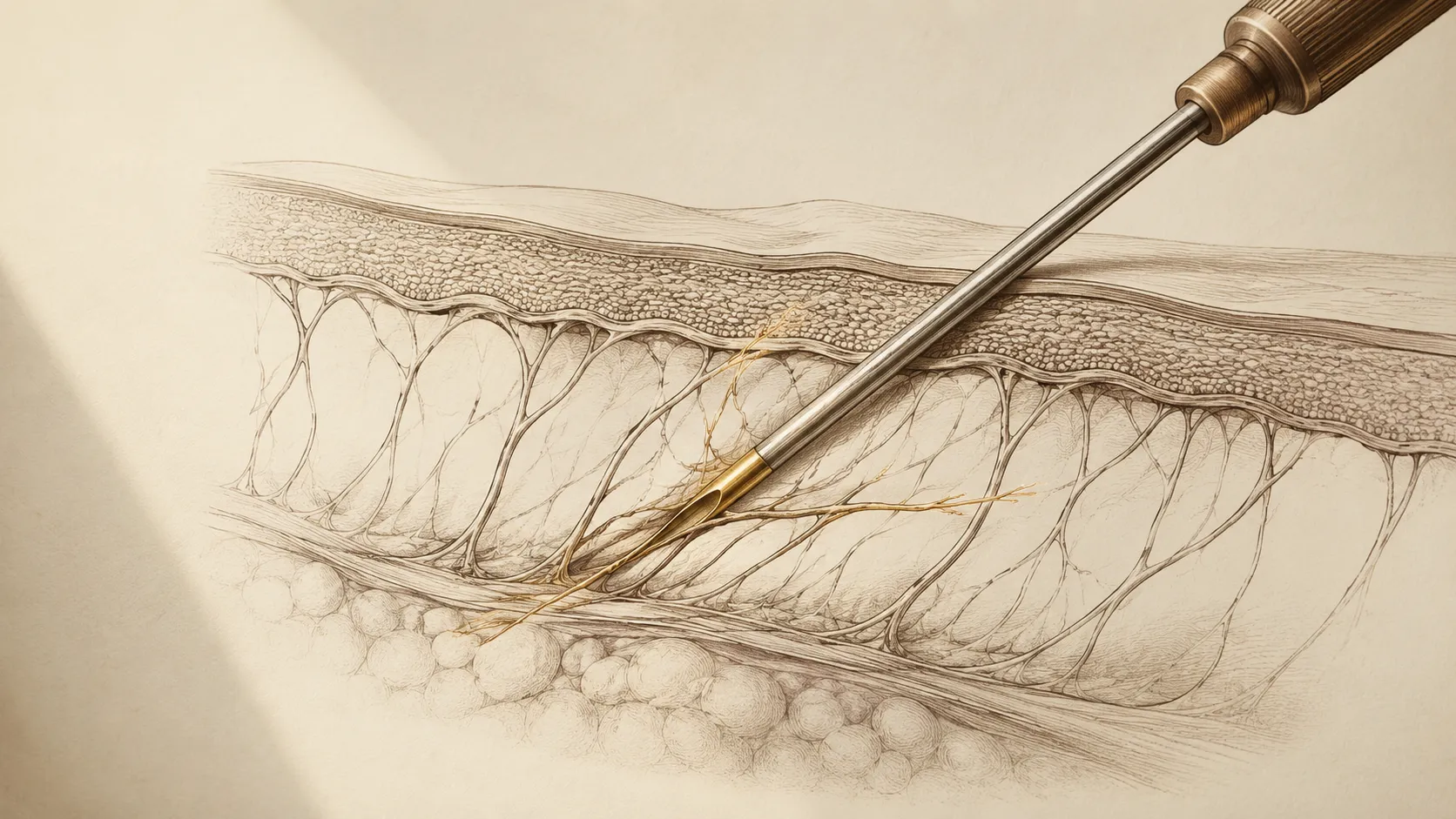
Subcision comes from Sub (under) + Incision (cut) — using a special needle under the skin to release the fibrosis tethering the skin into a depression.
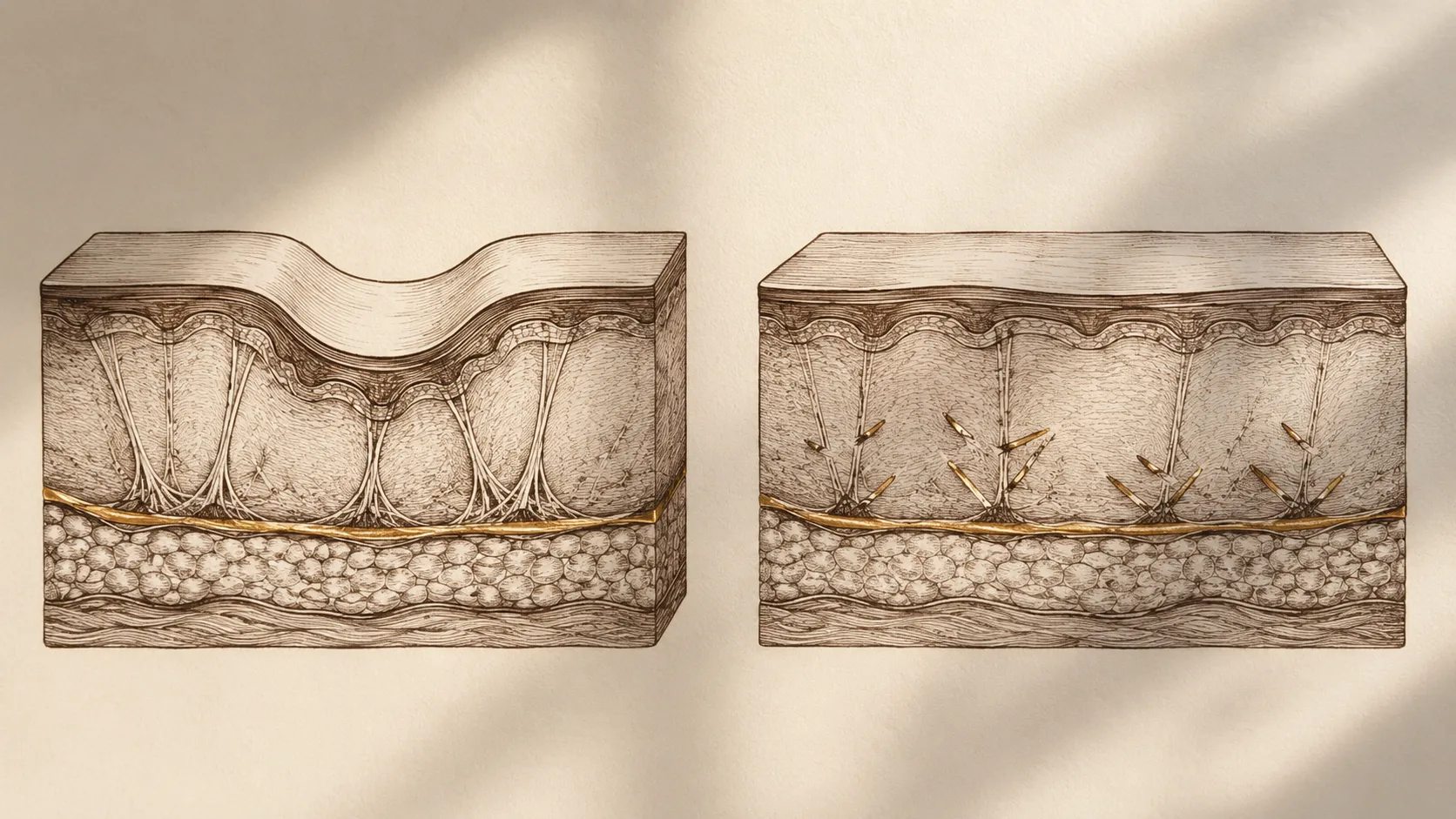
Where do the bands come from? When severe acne heals, the body forms scar tissue connecting tissue under the skin — this acts like a “rope” pulling the surface down.
Subcision is like cutting the rope pulling the skin into a pit — once cut, the skin can lift level with the surrounding skin.
Why can’t lasers do it?
A common question — “I’ve lasered many times, why is the scar still here?” The answer: lasers work at the surface (epidermis and shallow dermis), building new collagen in the layer they reach — but if fibrous bands still tether beneath, the new collagen gets pulled back down. Simply:
- Laser = refines the surface
- MNRF = builds mid-layer collagen
- Subcision = releases the tethering bands
Without releasing the bands first, laser and MNRF only get halfway.
Which scars Subcision suits
Rolling Scar — best fit
Soft edges, wave-like depression, clear tethering bands. Subcision is the first-line treatment.
Box Scar — secondary fit
Subcision releases bands first, then Ablative Fractional Laser refines the edges.
Ice Pick Scar — not suitable
Narrow and deep with no bands to release — TCA CROSS or Punch Excision suits better.
If unsure of your scar type, read Acne scar types — Rolling · Box · Ice Pick.
The Subcision process
Before: cleanse · numbing cream (lidocaine) 20–30 min · mark the scars. During: a special needle (cannula or Nokor) enters beside the scar → inserted at the dermal layer → releases the bands in a fan motion → repeat at other points → the body fills the gap with new collagen. ~15–30 minutes. After: bruising/redness 3–7 days · mild swelling · no picking or hard massage for 2 weeks · aftercare skincare + sunscreen.
Does Subcision hurt?
- Numbing: 20–30 min, a cold numb feeling
- First needle: a single “prick”
- Releasing bands: something moving under the skin — pressure, not sharp pain
- 1–2 hours after: numbness fades, a dull ache 3–4/10
- Next day: much less, usually no painkillers needed
Similar to a “fat needle” injection at the dentist — bearable, not work-stopping.
When do results show?
This is what many misunderstand — Subcision doesn’t shallow scars instantly.
- Immediately: the area “swells,” scars look temporarily shallow — that’s swelling, not the real result
- 1–2 weeks: swelling subsides, scars may look 80–90% back — don’t lose heart
- 4–8 weeks: new collagen fills the released gap, scars genuinely shallow
- 3–6 months after session 1: clearest result — about 30–50% shallower
- Repeat 3–6 sessions (4–8 weeks apart): cumulative 60–80%
Subcision’s results take time — biology isn’t in a hurry; collagen needs time to build.
Risks · cautions
Bruising (30–50% of cases, clears 1–2 weeks) · swelling (3–5 days) · subcutaneous bleeding (rare) · infection (very rare in a clean clinic) · subcutaneous bumps/nodules (resolve in 1–3 months). Don’t do it if: on blood thinners (Warfarin/Aspirin — stop first, always tell the doctor) · pregnant/breastfeeding · isotretinoin within 6 months · prone to keloids.
Subcision price in Thailand
| Clinic | Price/session |
|---|---|
| General clinics | 3,000–8,000 baht |
| Mid-tier | 8,000–15,000 baht |
| Premium | 15,000–25,000 baht |
| Clarity (incl. Subcision + MNRF + Ablative + Picolaser) | 5,000 baht |
Why does Clarity include all 4 for 5,000? Because acne scars should be treated at every layer in one session for the best result — instead of charging each procedure separately (20,000+), we set one lower price that treats everything.
Is Subcision alone enough?
Not enough for complete treatment. Subcision releases bands, but skin also needs: new collagen in the dermis (MNRF) · surface texture refinement (Ablative Fractional Laser) · dark-mark reduction at the base (Picolaser). Clarity does all 4 in one session — a clearer result and fewer total sessions.
Frequently asked questions
Q: What should I avoid after Subcision? A: No hard facial massage for 2 weeks · no squeezing acne · no peels or harsh skincare in the first week.
Q: How many sessions to see clear results? A: Generally 3–6, 4–8 weeks apart — a clear ~60–80%.
Q: Can men do it? A: Yes, very well — men’s collagen response is often better than women’s at the same age.
Q: Can I do Subcision with active acne? A: Not recommended — settle the acne first to reduce infection risk.
Q: How many days off? A: Most return to work the next day — some redness, coverable with foundation.
Summary
Subcision is essential for rolling scars and a key part of the gold standard. If you’ve lasered many times and still see the same scars, it may be because the bands were never released. At Clarity it’s part of the 5,000 baht/session program with MNRF, Ablative Fractional Laser, and Picolaser in one session.
Contact:
- LINE: @clarityclinic — send a photo of your acne scars for Dr. Big to review
- Location: Spring Tower, B Floor · Ratchathewi, near BTS (Siam, Phaya Thai, all Bangkok)
- Free 30-minute consult with Dr. Big in person
- Price 5,000 baht/session including all main procedures · pay per session, no course packages
Read next:
- Subcision: how many sessions to see results
- Filler vs Subcision for acne scars
- Does acne scar treatment hurt
- How many acne scar lasers are there
References
Outcomes vary by individual; this article is educational, not a substitute for in-person medical assessment.
- Orentreich DS, Orentreich N. Subcutaneous incisionless (subcision) surgery for the correction of depressed scars and wrinkles. Dermatol Surg. 1995. PubMed
- Jacob CI, Dover JS, Kaminer MS. Acne scarring: a classification system and review of treatment options. J Am Acad Dermatol. 2001. PubMed
- Gozali MV, Zhou B. Effective treatments of atrophic acne scars. J Clin Aesthet Dermatol. 2015. PubMed