Microneedle RF vs Ablative Laser: How They Differ for Acne Scars
Microneedle RF and ablative laser (CO2, Er:YAG) do different jobs: one helps volume, the other works scar edges. Which scars suit each, and the PIH risk, by Dr. Big.
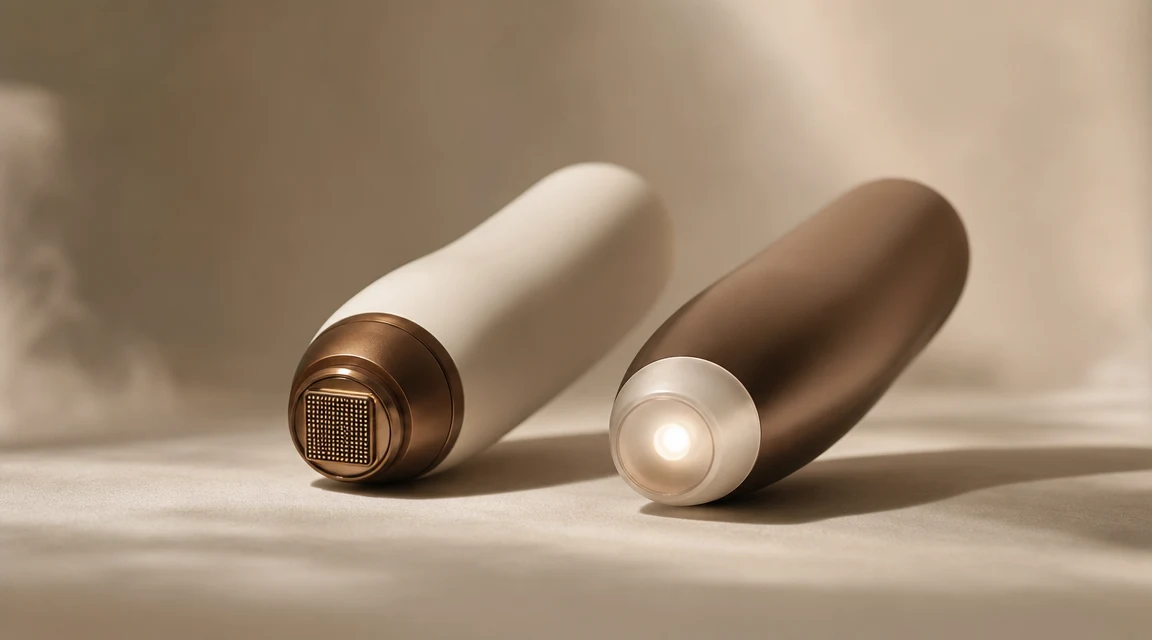
Quick answer: Microneedle RF and ablative laser do not replace each other, because they address different problems. Microneedle RF mainly helps volume under the skin and suits rolling scars without fibrous bands. Ablative laser (Er:YAG, CO2) works on steep scar edges. Microneedle RF does not change the steepness of the edge and does not cut fibrous bands, so deep scars often need ablative laser together with subcision and TCA CROSS, according to the doctor’s assessment.
“Which is better, microneedle RF or ablative laser (CO2/Er:YAG)?”
I hear this question often, but these two devices work by different mechanisms, address different problems, and carry different risks. The question to ask first is what your scars are stuck on.
In this article I compare the two and say which kind of scar each suits.
How they work: what is different
Microneedle RF (Microneedle Radiofrequency)
- Many small needles (25-49 needles per tip) enter the skin
- Radiofrequency (RF) energy is released at the needle tips in the dermis
- The RF heat stimulates new collagen under the skin, which helps volume
- It uses no light and does not peel the top layer, so the risk of dark marks is usually lower, but not zero
Ablative Fractional Laser (CO2 / Er:YAG)
- A high-intensity laser fired as micro-columns into the skin
- It “burns” tissue in many tiny spots
- The skin around each burned spot stays normal, which helps the skin repair
- It stimulates new collagen through “controlled injury”
- Full beam Er:YAG can be used to work the scar edge directly
Microneedle RF = heat under the skin through needles. Ablative = removing and burning the skin from the top.
Comparison table
| Factor | Microneedle RF | Ablative Fractional Laser |
|---|---|---|
| Mechanism | RF energy in the needles | Laser burns the skin |
| Main job | Volume under the skin | Texture and scar edges |
| Depth | 0.5-3.5 mm (adjustable, with care near the fat layer) | 0.3-2 mm (depends on wavelength) |
| Suits | Rolling scars without fibrous bands | Boxcar scars, steep edges, deep scars |
| Does not fix | Steep edges, fibrous bands, very narrow ice pick scars | Fibrous bands, very narrow ice pick scars |
| PIH risk | Lower | Higher in Asian skin, energy must be controlled |
| Sessions | 3-5 sessions, 4-6 weeks apart | 2-4 sessions, 8-12 weeks apart |
| Pain | Moderate (needs numbing) | Moderate to high (needs numbing) |
The number of sessions is a general guide. It really depends on the scars and the doctor’s assessment.
Microneedle RF: strengths and weaknesses
Strengths
- ✅ Helps volume under the skin without peeling the top layer
- ✅ Technique, energy, and depth can be adjusted to the scar
- ✅ The risk of dark marks is usually lower than with ablative
Weaknesses
- ⚠️ Does not change the steepness of the scar edge
- ⚠️ Does not cut fibrous bands
- ⚠️ Firing deep enough to reach the fat layer may make the fat shrink and the scar worse (the cheek is about 3 mm deep, but it differs from person to person)
- ⚠️ Very narrow ice pick scars cannot be reached by the needles and need TCA CROSS
Ablative Fractional Laser: strengths and weaknesses
Strengths
- ✅ Works directly on steep scar edges
- ✅ Refines the texture of the skin around the scar at the same time
- ✅ Used together with subcision, I aim for more contraction (this is my observation, not a research finding)
Weaknesses
- ⚠️ Higher PIH risk in Asian skin, so energy must be well controlled
- ⚠️ The skin needs good care afterwards
- ⚠️ It must be done by a skilled doctor. Too much energy can make the wound deep
Who suits microneedle RF better
- Rolling scars without fibrous bands, where the main problem is volume
- Cases that are not severe. Microneedle RF together with pico laser may be enough
- Skin with a high PIH risk that needs to avoid peeling
Who suits ablative laser better
- Boxcar scars or scars with steep edges. They show clearly because the steep edge casts a shadow
- The scar does not become shallower when you stretch the cheek (Skin Stretching Test). The problem is usually the steep edge, and the rim of the scar needs to be ground down
- You have had microneedle RF and the scars are still not shallower
- You want to refine texture over the whole face
What we use at Clarity
I start by reading the scars before choosing a device: the type, the depth, whether there are fibrous bands, and whether it is a texture or a volume problem.
- Cases that are not severe. The modern approach is microneedle RF together with pico laser
- Deep scars. The old school approach is ablative laser, layer by layer, together with subcision and TCA CROSS, making the scars shallower first and then refining the marks
See Acne scar lasers: the different types, How deep scars are treated, and Acne mark lasers: the different types
Combining them: the order within one session
Before treatment I examine the scars and do a 3D face scan before planning, apply numbing cream, and then work in this order, which cannot be swapped.
- TCA CROSS goes first, because if the skin swells I can no longer see the bottom of the scar
- Er:YAG full beam to work on the scar edges, done before subcision for the same reason
- Subcision with an 18G cannula + tumescent
- CO2 after the fibrous bands are released, because I want the most contraction (my intention based on what I have observed, not a research finding)
- Shallow fractional Er:YAG across the whole area to stimulate new skin formation
This set is chosen for each person’s scars. Not everyone needs every step.
Frequently asked questions
Q: Can PIH happen after microneedle RF? A: It can, but the risk is usually lower than with ablative, and most cases come from not wearing sunscreen after treatment.
Q: Will ablative CO2 make my skin look older? A: Not if the doctor controls the energy well. If the energy is too high, the skin can become thin and age faster.
Q: Can I have microneedle RF while I have inflamed acne? A: You should not. Wait until the acne has calmed down (4-6 weeks).
Q: Can I have microneedle RF and subcision on the same day? A: Yes, in cases where the doctor judges it suitable. Subcision addresses only the fibrous bands, while microneedle RF helps volume, and I rarely do subcision alone. Read the reasons in What is subcision
Q: Where can I get advice near BTS on microneedle RF or ablative laser? A: At Clarity Clinic Ratchathewi, a 1-minute walk from BTS Ratchathewi, easy to reach from Siam, Phaya Thai, and all over Bangkok. Dr. Big assesses and treats you himself, with a free 30-minute consultation.
Summary
- Microneedle RF = helps volume under the skin, suits rolling scars without fibrous bands
- Ablative laser = works scar edges and texture, PIH risk must be managed
These two devices address different problems, so I choose according to your scars. No single device does it all.
Contact:
- LINE: Message us @clarityclinic. Send a photo of your scars for Dr. Big to look at first, and ask which program suits your scars
- Location: Spring Tower, floor B, Ratchathewi, near BTS (Siam, Phaya Thai, all over Bangkok)
- Free 30-minute consultation with Dr. Big himself
Read next:
- Acne scar lasers: the different types
- Subcision: cutting the fibrous bands under the scar
- The 3 types of acne scars need different devices
References
Outcomes vary by individual; this article is educational, not a substitute for in-person medical assessment.
- Manstein D, Herron GS, Sink RK, et al. Fractional photothermolysis: a new concept for cutaneous remodeling using microscopic patterns of thermal injury. Lasers Surg Med. 2004. PubMed
- Gozali MV, Zhou B. Effective treatments of atrophic acne scars. J Clin Aesthet Dermatol. 2015. PubMed
- Chung HJ, Al Janahi S, Cho SB, Chang YC. Chemical reconstruction of skin scars (CROSS) method for atrophic scars: a comprehensive review. 2021. PubMed
Read the full overview: Acne scar treatment: the complete guide